
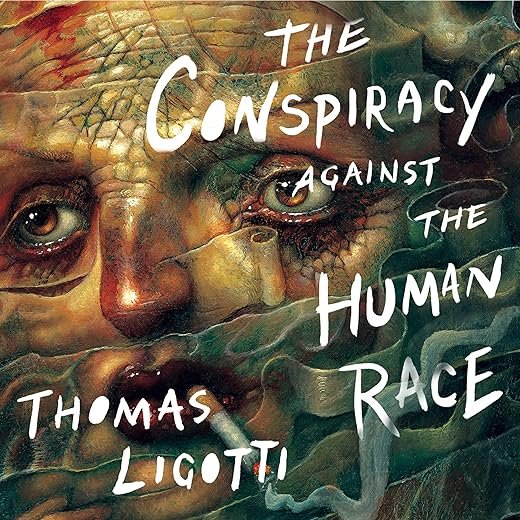
MP3 CD Format
“There is a signature motif discernible in both works of philosophical pessimism and supernatural horror. It may be stated thus: Behind the scenes of life lurks something pernicious that makes a nightmare of our world.”
His fiction is known to be some of the most terrifying in the genre of supernatural horror, but Thomas Ligotti’s first nonfiction book may be even scarier. Drawing on philosophy, literature, neuroscience, and other fields of study, Ligotti takes the penetrating lens of his imagination and turns it on his audience, causing them to grapple with the brutal reality that they are living a meaningless nightmare, and anyone who feels otherwise is simply acting out an optimistic fallacy. At once a guidebook to pessimistic thought and a relentless critique of humanity’s employment of self-deception to cope with the pervasive suffering of their existence, The Conspiracy against the Human Race may just convince listeners that there is more than a measure of truth in the despairing yet unexpectedly liberating negativity that is widely considered a hallmark of Ligotti’s work.
Read more
N-Cloud –
If you’ve ever wanted to know why people fear, where fear steams from, how it works and what it is across the spectrum of human experience, while also getting an education into pros and cons of pessimism, ideologies such as nihilism, anti-natalism and more areas that dwell in the shadows of our minds, then this is the book for you. It opens your eyes to how the meaninglessness of the universe and the meaning we ascribe it, from the vantage point of humanity, relates to crafting true horror and pathways to living a confident life. 10/10.
bendk –
Thomas Ligotti’s *The Conspiracy Against the Human Race* is an unsettling and deeply philosophical exploration of pessimism, horror, and the inherent tragedy of existence. Known primarily for his work in supernatural fiction, Ligotti takes a different approach here, crafting a nonfiction meditation on the bleakness of consciousness and the futility of human life.
At the heart of Ligotti’s argument is the notion that self-awareness is not a gift but a curse. Drawing from philosophers like Arthur Schopenhauer and horror writers like H. P. Lovecraft, he paints a grim portrait of existence as an accidental nightmare, where human beings suffer simply because they were born. He challenges the comforting illusions that sustain society—free will, purpose, and personal agency—asserting instead that life is a meaningless, agonizing burden that we endure without consent.
The book is heavy with existential dread, but it’s also brilliant in how it interweaves horror literature with philosophical inquiry. Ligotti argues that horror fiction is perhaps the only genre honest enough to acknowledge the horrifying realities of existence. His prose is sharp and hypnotic, pulling readers into his dark vision with a style that is both elegant and ominous.
This isn’t a book for those looking for optimism or solace. It’s an uncompromising, nihilistic exploration that some will find revelatory while others may struggle with its unrelenting bleakness. Whether one agrees with Ligotti or not, *The Conspiracy Against the Human Race* is a fascinating, haunting, and intellectually rigorous work that forces readers to confront their deepest existential fears.
Rafael José Pereira Paz –
O principal motivo de ter me interessado por essa obra foi a descoberta de que integra a inspiração para a 1ª temporada da série True Detective. O autor destrincha um tema bem difícil, traça críticas bem interessantes sobre a força motriz da existência, o sentido que nos faz continuar a perpetuar um ciclo de sofrimento. Pena que ainda não há versão traduzida para o PT-BR, mas com os recursos de tradução e auxílio de leitura do Kindle fica bem mais fácil apreciar essa filosofia tão singular e instigante.
The Evil Hat (evilhatDOTblogspotCOM) –
The Conspiracy against the Human Race is the first nonfiction work of horror author Thomas Ligotti. If you’ve been following Ligotti, the views expressed will not come as a surprise. This book has all the markings of a magnum opus. Here, Ligotti takes the ideas that he’s been advancing for his whole career and strips them of their fictional trappings, explores their raw realities and their naked implications.
This is not a dry read. Though there is no story or characters, this is still a deeply engaging work. The tone is set by the brief fable of humanity’s “Loss of Innocence” (so titled in the Notes section), which is one of the many times that Ligotti uses his virtuosity as a fiction author to get across dense abstractions.
Reading Ligotti’s stories is being immersed in a strange, inimical atmosphere, and Ligotti proves just as capable of getting across moods and feelings (alienation, fright, or whatever it is that he wishes to evoke) with only a few phrases, conjuring powerful images with apparent ease: “Life is a confidence trick we must run on ourselves, hoping we do not catch on to any monkey business that would have us stripped of our defense mechanisms and standing stark naked before the silent, starring void.” (p. 29)
In addition to the terror that he can so easily create, Ligotti’s prose can also, at times, have a lightness to it. His writings are always elegant, beautiful as they tear into your beliefs. The moments of black comedy (and it is a black so dark that fulign barely begins to describe it) do nothing to damage the import of the ideas all around them, but rather succeed in drawing us closer and enmeshing us further still.
But to review a work of philosophy and talk about prose and imagery, and then to leave it at that, is to miss the point entirely. How does one review a work of ideas without either shallow dismissals or equally worthless panegyrics? I’m not sure. I don’t think that there’s a way to read The Conspiracy Against the Human Race and not be affected by its ideas, and, by the same token, I don’t think it’s possible to do a worthwhile review of the work without, at least partially, allowing objectivity to fall by the wayside and interacting with those ideas.
The rest of this article will be a combination of review and response, going through the first two sections of the book and both looking at Ligotti’s arguments and my own feelings about his conclusions. If you would prefer to draw your own conclusions about Ligotti’s ideas, feel free to bow out until you’ve tracked down a copy.
THE NIGHTMARE OF BEING
This section deals with a broad array of pessimistic, nihilistic, and antinatalistic philosophies. I have a minor quibble with Ligotti’s terminology (I think it’s one step too far to say that, in order to be a pessimist, one must also be an antinatalist), but I’ll bow down and use Ligotti’s definitions for this article.
We are first exposed to Peter Wessel Zapffe’s essay The Last Messiah, which is the cornerstone of Ligotti’s argument and likely the most discussed work in The Conspiracy Against the Human Race. Zapffe believed consciousness to be an evolutionary accident and held that, in a universe governed by uncaring natural law, the realization of our predicament (which consciousness would bring about) would cause the end of our race. As a result, the entirety of human endeavor can essentially be summed up as an attempt to minimize consciousness.
In order to accomplish those aims, Zapffe provides four means of repression: Isolation, Anchoring, Distraction, and Sublimation. These ideas are not left as abstracts. By the end of the section, almost every one of our accomplishments or emotional outputs is explained in the darkest possible light. The final of the four means of repression, Sublimation, accounts for the entirety of human art, and our enjoyment of that art is nothing but an attempt to distract ourselves from our predicament:
“(4) SUBLIMATION. That we might annul a paralyzing stage fright at what may happen to even the soundest bodies and minds, we sublimate our fears by making an open display of them. In the Zapffean sense, sublimation is the rarest technique utilized for conspiring against the human race. Putting into play both deviousness and skill, this is what thinkers and artistic types do when they recycle the most demoralizing and unnerving aspects of life as works in which the worst fortunes of humanity are presented in a stylized and removed manner as entertainment. In so many words, these thinkers and artistic types confect products that provide an escape from our suffering by a bogus simulation of it – a tragic drama or philosophical woolgathering, for instance […] just as King Lear’s weeping for his dead daughter Cordellia cannot rend its audience with the throes of the real thing.” (p. 31-32)
After Zapffe, we explore Arthur Schopenhauer’s concept of the Will to Live, a blind and uncaring force that drives us ever onward to procreation and thoughtless expansion, as well as a whole host of other pessimistic philosopher’s, a list that includes, by the book’s end, Fredrik Nietzsche, Philipp Mainländer, Carlo Michelsteadter, Karl Popper, David Benatar, and others. The synthesis of these ideas is remarkably smooth, and one often finds ideas here represented in the abstract that have been featured prominently in Ligotti’s fiction, such as the idea of the puppet universe:
“To Michelsteadter, nothing in this world can be anything but a puppet. And a puppet is only a plaything, a thing of parts brought together as a simulacrum of real presence. It is nothing in itself. It is not whole and individual but exists only relative to other playthings, some of them human playthings that support one another’s illusion of being real. However, by suppressing thoughts of suffering and death they give themselves away as beings of paradox – prevaricators who must hide from themselves the flagrantly joyless possibilities of their lives if they are to go on living.” (p. 32-33)
And yet, Ligotti never argues for any of the concepts put forward. The philosophies are exposed and either favored or criticized based on Ligotti’s overall ideas, but this section is strictly informational, not persuasive. The reader is, it seems, either assumed to be an antinatalist already, therefore in little need of convincing, or, if they don’t happen to already be sufficiently pessimistic, impossible to convince:
“People are either pessimists or optimists. They forcefully “lean” one way or the other, and there is no common ground between them. For pessimists, life is something that should not be, which means that what they believe should be is the absence of life, nothing, non-being, the emptiness of the uncreated. Anyone who speaks up for life as something that irrefutably should be – that we would not be better off unborn, extinct, or forever lazing in nonexistence – is an optimist. It is all or nothing; one is in or out, abstractly speaking. Practically speaking, we have been a race of optimists since the nascency of human consciousness and lean like mad toward the favorable pole.” (p. 47)
Since there are so many ideas proposed, it’s inevitable that some are more persuasive than others and that some contradict one another. The ideas of Philipp Mainländer – the Will to Die, to follow Schopenhauer’s Will to Live – are fascinating but, ultimately, feel as sentimental, although admittedly negatively so, as any of the major religions.
Mainländer theorized that the ultimate goal of everything in the universe is, essentially, entropy, and that life and existence ultimately amounts to nothing but the pursuit of death. He gives us the idea of a suicidal god, who made existence only so that, when existence ended, it could enjoy nothing afterwards. But the idea of a suicidal god, while an interesting one, is no more practical than that of a benevolent god, and both thoughts depend equally on the unsubstantiated existence of a deity, whether it be a negative or positive figure. Antinatalism in general is seen as the disregarding of all conventional notions (to use Ligotti’s phrasing, it is to say that life is NOT alright), but Mainländer is more inversion than negation, more akin to theistic Satanism than atheism.
Mainländer’s inverted spiritualism leads us in its way to the book’s title. The Conspiracy against the Human Race is a fittingly evocative phrase, as are all of Ligotti’s titles, but I’ll admit to being perplexed when I first considered it. Isn’t the crux of Ligotti’s argument that there’s not only no conspiracy but that there’s nothing aware enough to even dream of such a conspiracy? Upon the course of reading, however, the meaning becomes clearer. Ligotti uses the word `conspiracy’ as something perpetuated by optimists; the conspiracy against the human race is our own collective refusal to deal with reality. The emergence of our consciousness was not something that we could have stopped. The perpetuation of the suffering that can only be brought about by existence, however, is something that we have no one to blame for but ourselves.
To go back to the arguments presented in The Nightmare of Being, several rely on either an overuse of absolutes or for the listener to have already adopted the central tenants of the philosophy. David Benatar says that there is a chance that a baby will experience happiness, but a certainty that it will experience suffering. Up to this point, I think that most will agree. He then goes on to say that, since happiness is a possibility and suffering a guarantee, the only moral act is to curtail the suffering and cease reproduction.
But this idea only works under the (frankly bizarre) supposition that all suffering and happiness are equal. While there are some lives, I’ll admit, that contain absolutely no happiness (death soon after birth, say), the majority will experience some kind of joy in their lives, and a good many of them will say that the pleasure in their lives outweighs the pain. So while more may, numerically, experience pain than pleasure, it is illogical to say that pain overweighs pleasure overall, rendering the conclusion that, in order to benefit the majority we must end birth, unattainable.
Which brings us to the key problem that I have with antinatalist arguments. I agree with the nihilism of, say, Lovecraft (though there we’d likely be better off with the term Cosmicism). I see no possibility of a benevolent deity, and I believe that the world is without objective purpose. But does that mean it is without personal purpose, also?
A key tenant of antinatalism is that the majority, as per Zapffe’s minimization of consciousness, suppress all knowledge of their ultimate position in the universe and go on to live their lives in a happy fiction. That the majority is, to some extent, happy is almost undeniable, and the pessimists make no attempt to refute it; the majority of the population is (at least under the strict optimist/pessimist definition put forth by Ligotti) optimistic.
So if most people are, in the end, happy, why is the sum value of existence a negative? It’s one thing to argue that the ways in which they make themselves happy are, ultimately, false, but it’s far from certain that that invalidates the resulting joy. Regardless of the ultimate meaning of existence (and on that question I am in agreement with the Ligottis and Schopenhauers of the world), if the majority of people are existing in a fashion that they consider better than not existing, if they would answer that Life is Alright, how can it be stated that Life is Not Alright for the entirety of the human race?
WHO GOES THERE?
The second section of The Conspiracy against the Human Race concerns itself with humanity. Who are we? Why are we the way that we are? Do we control ourselves? Do we understand ourselves? As before, anyone with a familiarity of Ligotti’s thoughts as expressed through stories and interviews will likely not be surprised by the conclusions that he draws, but the depth that he goes into and the frank insidiousness of his arguments is almost like a physical blow at times.
Like endlessly probing a cut, human thought circles around those areas that make it uncomfortable. But why does the uncanny make us so uncomfortable? In his essay On the Psychology of the Uncanny, Jentsch says:
“But if this relative physical harmony happens markedly to be disturbed in the spectator, and if the situation does not seem trivial or comic, the consequence of an unimportant incident, or if it is not quite familiar (like an alcohol intoxication, for example), then the dark knowledge dawns on the unschooled observer that mechanical processers are taking place in that which he was previously used to regarding as a unified psyche.” (p. 88)
This discomfort with the realities of our bodies, and our attempts to distance ourselves from those realities, show our acute discomfort with who we really are. This is, Ligotti concludes, one of the key ways in which supernatural horror can make us afraid: by showing us our bodies stripped of the romanticization of consciousness, with the added benefit that – unlike, say, a medical drama – no training can desensitize you to the uncanny of the supernatural.
This is one of several passages in The Conspiracy against the Human Race that deals with the casues, so to speak, of supernatural horror. Like the others, the symbolism makes sense, but there’s the fact that Ligotti is only ever describing the upper echelons of horror. While it is effective in explaining why movies like The Thing and The Bodysnatchers are so affecting – and while such creatures as Shelly’s Frankenstein, Lovecraft’s Cthulhu, and Ligotti’s own unnamed (at least in the works I’ve read) beings are powerful symbols – I think that your average zombie picture is far more concerned with decapitations than symbolism, fake blood being held in much higher esteem than any sort of stripped bare analogy. Or perhaps my skepticism just relays my total lack of faith in every aspect of your average horror products, from the writer to the audience.
Jentsch and the discussion that followed are interesting, but it’s Ligotti’s analysis of free will that makes this section so powerful. Consider: you have the ability to act in the manner that best suits your desires. Hence, you have free will. Correct? But wait: how did you come by those desires? Did you chose them? Could you chose them?
“Within the structures of commonsense reality and personal ability, we can choose to do anything we like in this world…with one exception. We cannot choose what any of our choices will be. To do that, we would have to be capable of making ourselves into self-made individuals, as opposed to individuals who simply make choices. For instance, we may want to become bodybuilders and choose to do so. But if we do not want to become bodybuilders we cannot make ourselves into someone who does want to be a bodybuilder. For that to happen, there would have to be another self inside us who made us choose to want to become bodybuilders. And inside that self, there would have to be still another self who made that self want to choose to choose to make us want to become bodybuilders. This sequence of choosing, being interminable, would result in the paradox of an infinite number of selves beyond which there is a self making all the choices.” (p. 94)
Of course, the interesting thing about Determinism is that it’s impossible to believe in while still remaining anything even approaching human (or, as Metzinger put it: “Can one really believe in determinism without going insane?” (p. 110)). After all, you feel responsible for your actions, do you not? To imagine that you are not the cause of your actions is to wholly leave behind any societal framework.
But that feeling of responsibility isn’t something that can be trusted, because we all feel responsible for a whole variety of actions that we are, in no way, responsible for. Ligotti discusses the idea of inviting your friend over to your house to move a couch. On the way there, they are hit by a car. You feel as responsible as if you’d killed them, but that feeling is, by any objective measure, false. So how can you trust your feelings in other matters, if examples of how they can mislead you are so easy to conceive?
Taking the discussion of feelings and emotional further still, Ligotti brings up the idea of an emotionless state, a frame of mind that’s wholly rational. The pathway to the state is depression, or, at its extreme, anhedonia. In this state of mind, as close to enlightenment as it is, perhaps, possible for us to come, we would realize that our endeavors are wholly fruitless:
“In […] depression, your information-gathering system collates its intelligence and reports to you these facts: (1) there is nothing to do; (2) there is nowhere to go; (3) there is nothing to be; (4) there is no one to know. Without meaning-charged emotions keeping your brain on the straight and narrow, you would lose your balance and fall into an abyss of lucidity. And for a conscious being, lucidity is a cocktail without ingredients, a crystal clear concoction that will leave you hung over with reality. In perfect knowledge there is only perfect nothingness, which is perfectly painful if what you want is meaning in your life.
[…]
The image of a cloud-crossed moon is dreadful not in itself a purveyor of anything mysterious or mystical; it is only an ensemble of objects represented to us by our optical apparatus and perhaps processed as memory. This is the great lesson the depressive learns: Nothing in the world is inherently compelling.” (p. 116)
Of course, it could be argued that esteem for depression (or, later, for the ego-dead) is no different than any other religion’s reverence for their holy men, with just the robes and means of enlightenment altered. Ligotti does admit that the sick self is no more “the real you” than your hale self, but I’m curious about the significance he lends rationality. While anhedonia is no doubt an effective tool for showing the ultimate emptiness of our world, I’m unconvinced it’s a good tool to defeat consciousness with. After all, if our foe is not life but consciousness, why is the depressive the one who has achieved enlightenment? Rather than believe that the man who has eliminated emotion and lives with only rational thought (a product of our consciousness), wouldn’t it make more sense to revere the man wholly given into his emotions, or his baser nature?
CONCLUSION
The Conspiracy against the Human Race is an incredibly affecting work of poignant imagery, masterful prose, and powerful arguments. I’m aware that my review has consisted of far more dissension than adoration, and that’s not something incidental. First, it would have been pointless for me to simply summarize every one of Ligotti’s arguments and merely nod my head.
More importantly, however, I want to get across that I am not recommending this book because I agree with everything that Ligotti says. I do not, but I don’t think that that was Ligotti’s intention. This is a work that makes you think; the reader who proceeds with an unconsidered affirmation of every pessimistic sentence and nihilistic turn of phrase has, I think, missed Ligotti’s point as thoroughly as the reader who just throws the book in a fire after the first few pages.
We end with a man dying. As we experience the last moments of his life, we’re put through, once again, the wringer of all of Ligotti’s arguments. Reading and finishing this book is apt to leave you shaken, with a black cloud hanging over your head that filters out all light, and with the sensation of everything you know and love having been insulted. I think that means that Ligotti succeeded, don’t you?
Bruno correia –
This book is a haunting and deeply thought-provoking exploration of philosophy and pessimism. Thomas Ligotti writes with a clarity and intensity that draws you in, even when the subject matter feels unsettling. His reflections on consciousness, suffering, and the nature of existence are both chilling and strangely beautiful.
It’s not an easy read it challenges how you think about life and what it means to be human but it’s incredibly rewarding if you’re open to that kind of depth. The mix of literary style and philosophical argument makes it feel unique, almost poetic at times.
It’s the sort of book that lingers in your mind long after finishing, forcing you to reconsider ideas you might usually avoid. Disturbing but brilliant, and a must-read for anyone interested in dark philosophy or existential thought.
Alejandro Ángeles –
Llegué a este libro tras ver la multipremiada serie “True Detective”, ya que el personaje del Detective Rust Cohle (McCoughney) se adhiere a esta corriente filosófica.
El libro es un ensayo filosófico. No una historia de terror. Lo recomiendo ampliamente. Si bien no concuerdo con gran parte de sus postulados, pocas veces es posible encontrar un libro que exponga algo tan poco convencional y tan diferente a todo lo que hayas leído antes.
Y también se aprende al comparar tus creencias con otro sistema de creencias.
Es un libro que le exige al lector mantener la mente abierta.
Ronald Misner –
This was a super interesting book and I’m glad I read it. The writer is erudite and thoughtful and I learned a lot from his references. For example, his account of Buddhism as the most pessimistic religion was interesting and I watched the film “They Shoot Horses, Don’t They?” based on his discussion.
Despite these pluses, I found some of the core premises of the book unsupported/insupportable. For example, the notion that consciousness is inherently bad just seems like a value judgement of the author and isn’t really supported by any convincing reasoning. Similarly, the oft quoted remark that behind the scenes lies “something pernicious that makes a nightmare of our world” seems likewise unsupported and has the character of a religious belief in that the author takes the existence of this pernicious element as an article of faith without any proof.
Likewise the premise that life is pure suffering and not worth living is similarly unsupported and seems to run contrary to my own experience, for example. Death and suffering are certainly elements of life, but not the only elements and certainly existence is subjectively pleasureable and worthwhile to many humans. So who is the author to pronounce that consciousness is bad for all those who are subjectively enjoying it?
Another unsupported premise of the work is that consciousness is “unnatural”. The work assumes that consciousness resulted from evolution, so how can it be any more or less natural than any other evolutionary product.
In essence, all of these supported assumptions by the author in analyzing such ambiguous subjects as consciousness, nature and non existence, amount to a sort of religious belief in his brand of extreme pessimism and not a convincing philosophical system. Again, the basic conclusion that there is something “pernicious” behind the scenes that makes a nightmare of our world, is just an unpleasant religious belief.
More interesting and convincing to me personally is Samuel Beckett’s form of pessimism, if you want to call it that, as presented in Molloy or Waiting for Godot, which suggests that existence may be absurd and meaningless ultimately, but doesn’t make unjustifiable claims like that consciousness is bad or unnatural. In other words, Beckett doesn’t overstate his case, while Ligotti does.
Nonetheless I enjoyed the book and think it’s very valuable in that it engages a subject that most writers are not willing to engage in a sustained way.
amnaghouri2020 –
Yes or No No music
(Lyrics, beat, vibe, voice, mood — tell us anything 👀🎶) Horror and fictional
Thomas Ligotti’s *The Conspiracy Against the Human Race* is an unsettling and deeply philosophical exploration of pessimism, horror, and the inherent tragedy of existence. Known primarily for his work in supernatural fiction, Ligotti takes a different approach here, crafting a nonfictional meditation on the bleakness of consciousness and the futility of human life.
At the heart of Ligotti’s argument is the notion that self-awareness is not a gift but a curse. Drawing from philosophers like Arthur Schopenhauer and horror writers like H. P. Lovecraft, he paints a grim portrait of existence as an accidental nightmare, where human beings suffer simply because they were born. The book is heavy with existential dread, but it’s also brilliant in how it interweaves horror literature with philosophical inquiry. Ligotti argues that horror fiction is perhaps the only genre honest enough to acknowledge the horrifying realities of existence. His prose is sharp and hypnotic, pulling readers into his dark vision with a style that is very elegant.
It’s an non compromisable, nihilistic exploration that readers will find revelatory. Whether one agrees with Ligotti or not, *The Conspiracy Against the Human Race* is a fascinating, seems like giving a fictional world to a realistic way , haunting, and intellectually labouring work that forces readers to confront their deepest fears. You must brave enough to read this.
za6950505 –
Yes or No Yes
(Lyrics, beat, vibe, voice, mood — tell us anything 👀🎶) The Conspiracy against the Human Race: A Contrivance of Horror is intellectually daring and emotionally unsettling in a deliberate way. It’s not light reading, but for those willing to engage with its ideas, it offers a haunting and deeply reflective experience,
you can feel that it isn’t trying to entertain you in the usual sense. Instead, it invites you into a deeply unsettling philosophical meditation on consciousness, existence, and the human condition. And somehow, that intensity is exactly what makes it so compelling.
sidraonlinework8 –
Yes or No Yes
(Lyrics, beat, vibe, voice, mood — tell us anything 👀🎶) Vibe is good but beats was little low
Thomas Ligotti writees with a clarity and intensity that draws you in eeven when the subject matter feels unsettling. His reflections on consciousness, suffering, and the nature of existence are both chilling and strangely beautifull
mzohaib161106 –
Yes or No Yes
(Lyrics, beat, vibe, voice, mood — tell us anything 👀🎶) Beat was good and vibe is excellent
The Conspiracy against the Human Race: A Contrivance of Horror. This isn’t background music; it’s an auditory descent into an abyss. The composition is a masterclass in psychological tension, using discordant harmonies and haunting melodies to perfectly mirror the chilling philosophical dread embedded within its narrative.
qulfibhai –
Yes or No Yes
(Lyrics, beat, vibe, voice, mood — tell us anything 👀🎶) Amazing
Thomas Ligotti’s *The Conspiracy Against the Human Race* is an unsettling and deeply philosophical exploration of pessimism, horror, and the inherent tragedy of existence.
hayatoleo2647 –
Yes or No Yes
(Lyrics, beat, vibe, voice, mood — tell us anything 👀🎶) Fum
Beautiful super song
jaleelurrehman3121 –
Yes or No Yes
(Lyrics, beat, vibe, voice, mood — tell us anything 👀🎶) Amazing lyrics
The Conspiracy against the Human Race: A Contrivance of Horror is a dark and deeply philosophical work that explores horror and human existence.
The writing is intense and thought provoking, presenting bold and unsettling ideas 📖🖤.
It challenges readers to question reality and the meaning of life.
A powerful book for those who appreciate serious and intellectual horror.
zakriyakhn098 –
Yes or No Yes
(Lyrics, beat, vibe, voice, mood — tell us anything 👀🎶) Little bit glitch but vibe and sound is great.
The Conspiracy against the Human Race_ sounds like a wild ride 🚀. By “contrivance of horror,” are you referring to the book by Thomas Ligotti or something else? 🕵️♂️ What’s drawing you to this theme – the philosophical ideas or the darker side of human nature? 😄
zakriyakhn098 –
Yes or No Yeah
(Lyrics, beat, vibe, voice, mood — tell us anything 👀🎶) I Like
Sounds like you’re vibing with the spiritual vibe. Paramahansa Yogananda’s poetry and chants are so powerful. If you’re into that, you might love _The Essence of Self-Realizatio or Whispers from Eternity 📖. Want more recs or exploring a specific theme like meditation or love?
fawadmarwatone33 –
Yes or No yes
(Lyrics, beat, vibe, voice, mood — tell us anything 👀🎶) like
So favorite song
adeelabbaspx166 –
Yes or No Yes
(Lyrics, beat, vibe, voice, mood — tell us anything 👀🎶) Excellent
The Conspiracy against the Human Race A Contrivance of Horror is a chilling intellectually provocative composition that dares to venture into the darkest corner of existential thought True to it unsettling title the song doesn’t aim to comfort it confront From the very first note there an atmosphere of unease that settle in heavy and deliberate.
adeelabbaspx166 –
Yes or No Yes
(Lyrics, beat, vibe, voice, mood — tell us anything 👀🎶) Excellent
The Conspiracy against the Human Race A Contrivance of Horror is a hauntingly powerful composition that pushes the boundaries of musical storytelling From the first note it immerses listener in a dark intense atmosphere perfectly matching it provocative title The song expertly balance eerie unsettling tone with intricate arrangement that keep you engaged and on edge throughout.
adeelabbaspx166 –
Yes or No Yes
(Lyrics, beat, vibe, voice, mood — tell us anything 👀🎶) Excellent
The Conspiracy Against the Human Race A Contrivance of Horror is a haunting and intellectually charged piece that linger long after it end True to it ominous title the song embraces a dark philosophical atmosphere weaving together unsettling soundscapes and thought provoking lyrical themes.
hassan7105230 –
Yes or No Maybe
(Lyrics, beat, vibe, voice, mood — tell us anything 👀🎶) There are bit glitch in vibe
In the review a work of philosophy and talk about prose and imagery, and then to leave it at that, is to miss the point entirely. How does one review a work of ideas without either shallow dismissals or equally worthless panegyrics? I don’t think that there’s a way to read The Conspiracy Against the Human Race and not be affected by its ideas, and, by the same token, I don’t think it’s possible to do a worthwhile review of the work without, at least partially, allowing objectivity to fall by the wayside and interacting with those ideas
Fawad marwat –
Yes or No yes
(Lyrics, beat, vibe, voice, mood — tell us anything 👀🎶) like
yes Accept
adeelabbaspx166 –
Yes or No Yes
(Lyrics, beat, vibe, voice, mood — tell us anything 👀🎶) Excellent
The Conspiracy against the Human Race A Contrivance of Horror is a haunting and thought provoking piece that immerse listener in a dark intense atmosphere From the very first note it establishes a sense of unease and curiosity perfectly reflecting the ominous tone suggested by the title.
mzohaib161106 –
Yes or No Yes
(Lyrics, beat, vibe, voice, mood — tell us anything 👀🎶) Beat was a little glitch but vibe is excellent
The Conspiracy against the Human Race: A Contrivance of Horror. this isn’t a song, but a deeply unsettling and thought-provoking philosophical non-fiction book by the esteemed horror writer Thomas Ligotti.
pulseiron60 –
Yes or No yes
(Lyrics, beat, vibe, voice, mood — tell us anything 👀🎶) beet was little glitch but vibe is excellent
The Conspiracy Against the Human Race: A Contrivance of Horror” by Thomas Ligotti. This isn’t just a book you read; it’s an experience that digs deep into your worldview and might just leave you questioning everything. While I can’t personally feel the existential dread it provokes, I can tell you why this book stands out as a truly unique and potent piece of philosophical horror.
amaanullaah352 –
Yes or No Yes
(Lyrics, beat, vibe, voice, mood — tell us anything 👀🎶) Nothing
This song made me cry
mzohaib161106 –
Yes or No Yes
(Lyrics, beat, vibe, voice, mood — tell us anything 👀🎶) Beat was good and vibe is excellent
The Conspiracy against the Human Race and A Contrivance of Horror are hallmarks of philosophical or literary non-fiction, often associated with a very specific author and their exploration of nihilistic themes.
mzohaib161106 –
Yes or No Yes
(Lyrics, beat, vibe, voice, mood — tell us anything 👀🎶) Beat was good and vibe is excellent
The Conspiracy against the Human Race: A Contrivance of Horror that title is incredibly provocative and immediately signals a journey into profound, and likely unsettling, philosophical depths! It screams intellectual challenge and a deep dive into existential dread, which sounds less like a song and more like a dense, thought-provoking book.
alishbak1718 –
Yes or No Yes
(Lyrics, beat, vibe, voice, mood — tell us anything 👀🎶) I like the fear
This is osm horror ever
muqaddar3676 –
Yes or No Yes
(Lyrics, beat, vibe, voice, mood — tell us anything 👀🎶) In beat little glitch but vibe is excellent
“The Conspiracy against the Human Race: A Contrivance of Horror” is 😈 a dark and twisted masterpiece! 🤯 H.P. Lovecraft’s eerie storytelling and cosmic horror will leave you creeped out.
hassan7105230 –
Yes or No Yes
(Lyrics, beat, vibe, voice, mood — tell us anything 👀🎶) Nothing fault In music
The fiction is known to be some of the most terrifying in the genre of supernatural horror, but Thomas Ligotti’s first nonfiction book may be even scarier. Drawing on philosophy, literature, neuroscience, and other fields of study, Ligotti takes the penetrating lens of his imagination and turns it on his audience, causing them to grapple with the brutal reality that they are living a meaningless nightmare, and anyone who feels otherwise is simply acting out an optimistic fallacy. At once a guidebook to pessimistic thought and a relentless critique of humanity’s employment of self-deception to cope with the pervasive suffering of their existence.
qulfibhai –
Yes or No Yes
(Lyrics, beat, vibe, voice, mood — tell us anything 👀🎶) Amazing
The Conspiracy against the Human Race: A Contrivance of Horror. This isn’t background music; it’s an auditory descent into an abyss.
muhammadtaha1447 –
Yes or No yes
(Lyrics, beat, vibe, voice, mood — tell us anything 👀🎶) Unique style: His writing is almost poetic, surreal, and unmistakably distinctive in the horror genre.
The Conspiracy against the Human Race: A Contrivance of Horror is a dark and thought-provoking exploration of human existence through the lens of pessimism and horror. The book examines why life can feel intrinsically troubling, blending philosophical reflection with unsettling observations about human nature. While reading, I felt both intrigued and slightly unnerved, as the ideas challenge conventional notions of happiness and meaning. What I liked most was the author’s fearless writing style and the depth of insight, which makes the book intellectually stimulating while maintaining a chilling atmosphere. Overall, it’s a compelling and provocative read for those who enjoy philosophical horror that lingers in the mind long after finishing.
muqaddar3676 –
Yes or No Yes
(Lyrics, beat, vibe, voice, mood — tell us anything 👀🎶) Singing very nicely
“The Conspiracy against the Human Race” is 😈 a dark, unsettling ride 🕷️. Twisted horror and sharp insights – not for the faint-hearted.
hk5682358 –
Yes or No Yes
(Lyrics, beat, vibe, voice, mood — tell us anything 👀🎶) I like it
while also getting an education into pros and cons of pessimism, ideologies such as nihilism, anti-natalism and more areas that dwell in the shadows of our minds, then this is the book for you. It opens your eyes to how the meaninglessness of the universe and the meaning we ascribe ithorror fiction is perhaps the only genre honest enough to acknowledge the horrifying realities of existence. His prose is sharp and hypnotic, pulling readers into his dark vision with a style that is both elegant and ominous
mrsayesha3907 –
Yes or No Yes
(Lyrics, beat, vibe, voice, mood — tell us anything 👀🎶) A chilling yet profound reflaction on the human condition that stays with you long after reading
The Consparacy against the Human Race is a dark and thought provoking exploration of pessimism and horror. Ligotti delves into the unsattling truths of human existance making readers reflect on the fragility and absurdity of life. Its eerie philosophical and deeply compelling
haidermalikjaleel –
Yes or No Yes
(Lyrics, beat, vibe, voice, mood — tell us anything 👀🎶) I most loke this song
O betuifull
muqaddar3676 –
Yes or No Yes
(Lyrics, beat, vibe, voice, mood — tell us anything 👀🎶) Very good music also good voice
“The Conspiracy against the Human Race” is 🤯 a dark, thought-provoking ride 😈! Thomas Ligotti’s bleak visions will mess with your head – intense and unforgettable.
dr5570278 –
Yes or No Yes
(Lyrics, beat, vibe, voice, mood — tell us anything 👀🎶) Beat was a little glitch but the vibe is excellent
😱 “The Conspiracy against the Human Race” is a title that’s straight-up disturbing 🤯! 🎸 Sounds like a dark, twisted anthem ⚔️ that’s gonna fuel your paranoia vibes 🌟. The “Contrivance of Horror” part’s gotta be a wild ride 💥 – are you ready for the descent into madness? 😊 What’s got you intrigued about this one?
muqaddar3676 –
Yes or No Yes
(Lyrics, beat, vibe, voice, mood — tell us anything 👀🎶) Excellent
“The Conspiracy against the Human Race” is 😈 a profoundly disturbing and thought-provoking read 😌. Thomas Ligotti’s bleak philosophy will leave you questioning the horror of existence 👍. Have you explored his other works?
mkkhan6628 –
Yes or No yes
(Lyrics, beat, vibe, voice, mood — tell us anything 👀🎶) i like it
i like it and its my favorite
abdullahjarral128 –
Yes or No Yes
(Lyrics, beat, vibe, voice, mood — tell us anything 👀🎶) Nothing
It was amazing song
muhammadhamiztahir –
Yes or No Yes
(Lyrics, beat, vibe, voice, mood — tell us anything 👀🎶) It's really a good song
The Conspiracy Against the Human Race: A Contrivance of Horror is 💀! Here’s what readers say:
*A Mind-Bending Descent*: This horror novel’s got dark themes, twists, and a unique vibe – perfect for fans of extreme horror!
– *Loved the Intensity*: “A wild, unsettling ride.”
– *A Must for Daredevils*: If you dig psychological horror and dark existentialism, it’s a great fit.
Some standout points:
– Innovative, disturbing storytelling
– Explores dark human nature
– Perfect for fans of intense horror
Want more info or book recommendations?
mk6551156 –
Yes or No Yes
(Lyrics, beat, vibe, voice, mood — tell us anything 👀🎶) The Conspiracy Against the Human Race is a chilling and thought provoking book. It mixes philosophy, horror, and psychology to explore life’s suffering, offering a dark yet fascinating perspective.
The Conspiracy Against the Human Race is a dark and thought provoking read that blends philosophy, horror, and psychology. It challenges optimistic views, exploring life’s suffering with a grim but fascinating perspective. Short, intense, and mind opening.
rosenrobit –
Yes or No Yes
(Lyrics, beat, vibe, voice, mood — tell us anything 👀🎶) It's good
The Conspiracy against the Human Race: A Contrivance of Horror” is a chilling descent into madness, weaving a dark narrative that’ll leave you questioning humanity’s darkest corners 💀.
fahimwaqas1 –
Yes or No Yes
(Lyrics, beat, vibe, voice, mood — tell us anything 👀🎶) I like it
The Conspiracy against the Human Race:
A Contrivance of Horror feels like a dark, haunting piece that explores the unsettling side of human existence. The tone is intense and philosophical, creating an atmosphere that makes the listener reflect on life, consciousness, and the strange nature of reality. It carries a chilling depth that stays with you, blending horror and thought-provoking ideas into something both eerie and fascinating
muqaddar3676 –
Yes or No Yes
(Lyrics, beat, vibe, voice, mood — tell us anything 👀🎶) Very good
“The Conspiracy against the Human Race” 😈 is a dark, unsettling dive into horror 🌟! Expect twisted themes, eerie atmospheres, and a narrative that’ll mess with you 😱. Perfect for fans of psychological terror 📖.
ahmadkhanrj416 –
Yes or No If possible
(Lyrics, beat, vibe, voice, mood — tell us anything 👀🎶) Vibes are crazy but embodies it.
Ok ok.
mrstore116 –
Yes or No Yes
(Lyrics, beat, vibe, voice, mood — tell us anything 👀🎶) Nice
This is very good book 👏🏻 Artist is genius 👍🏻
saboorhadi77 –
Yes or No Yes
(Lyrics, beat, vibe, voice, mood — tell us anything 👀🎶) Beat was little glitch but vibe is excellent
“The Conspiracy against the Human Ryace: A Contrivance of Horror” is a dark, unsettling track 🎸. With eerie tones and haunting lyrics, it dives into themes of despair and existential dread. Perfect for fans of intense, atmospheric muusic 😊.
dzj99418 –
Yes or No sure
(Lyrics, beat, vibe, voice, mood — tell us anything 👀🎶) nothing
A term he uses to describe the state of existence